



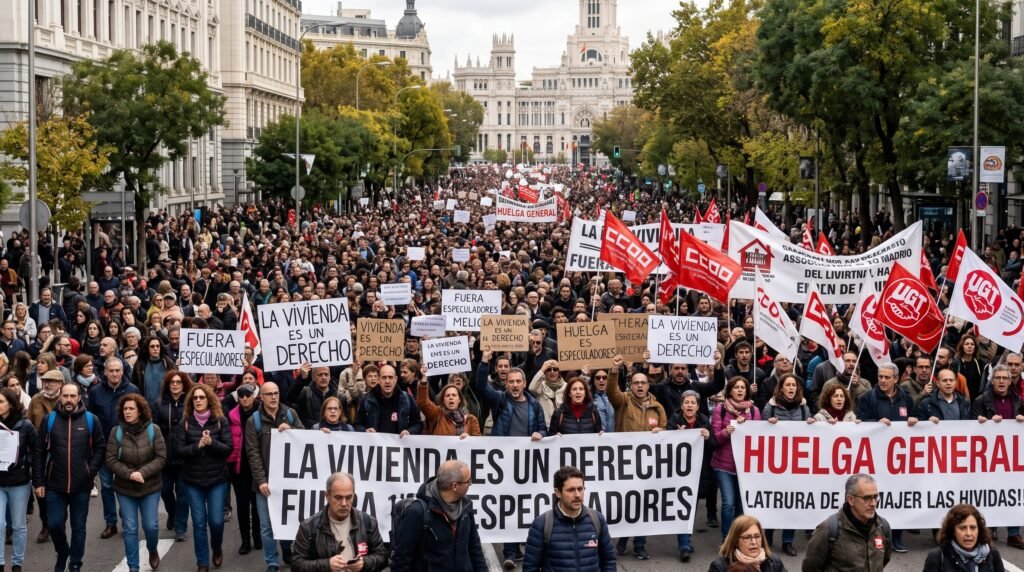
MADRID / ROME — Major European nations faced widespread social and institutional disruption on Wednesday, November 11, as millions of workers in Spain staged their first general strike in 14 years over a deepening housing crisis, while hundreds of schools across Italy, the United Kingdom, and Ireland were targeted by a coordinated wave of hoax bomb threats.
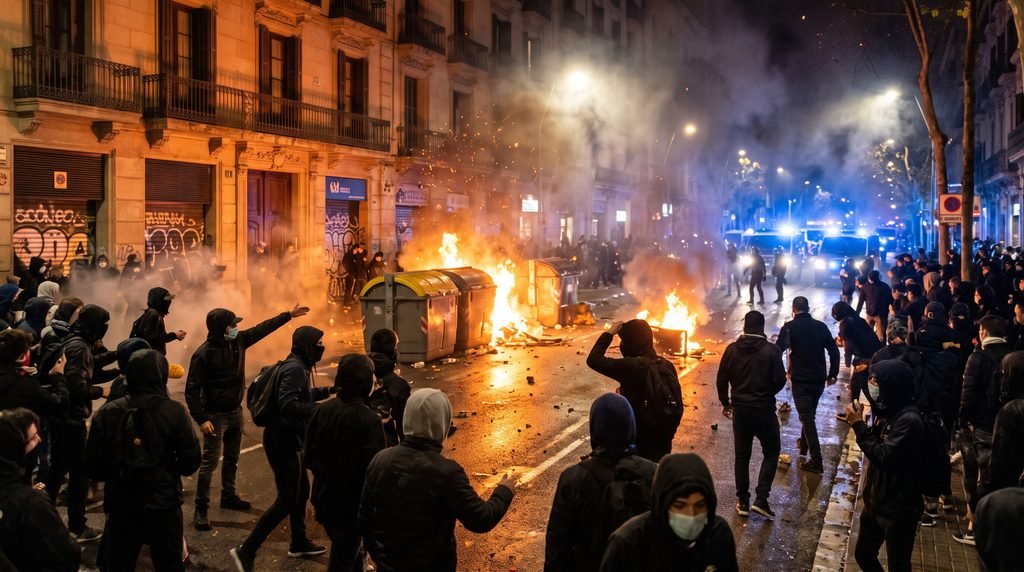
Fiery Clashes Erupt Amid Spain’s Historic General Strike
In Spain, a 24-hour nationwide general strike called by the country’s largest labor unions, CC OO and UGT, alongside tenant organizations, brought major cities to a standstill. Union leaders and tenant associations estimated that roughly 4 million people participated in the walkout, demanding lower housing costs, rent controls, and higher wages to combat a severe cost-of-living squeeze.
While daytime marches drew massive, largely peaceful crowds—with authorities estimating 120,000 demonstrators in Madrid and 55,000 in Barcelona, though organizers placed turnout at 600,000 and 400,000 respectively—tensions boiled over into violence in several urban centers:
- Barcelona: Workers erected roadblocks using burning tires at dawn, blocking key arteries including the AP-7 motorway and paralyzing public transit. By nightfall, small groups of hooded protesters clashed with riot police, setting fire to garbage containers and bicycles, hurling fireworks and firebombs, and vandalizing storefronts.
- Madrid: Scuffles broke out between pickets and police near the capital’s main wholesale market, while demonstrators temporarily halted traffic along the central Gran Vía. Many downtown businesses boarded up shop windows in anticipation of unrest.
- Nationwide Impact: Government officials reported more than 80 arrests and dozens of injuries among police and protesters across the country. Heavy rain and storm warnings forced the cancellation of planned afternoon marches in several southern Andalusian cities, including Seville and Córdoba, and eventually dispersed late-night crowds in Barcelona.
The strike comes weeks ahead of a high-stakes snap general election on November 29, called by Prime Minister Pedro Sánchez after conservative and far-right opposition parties voted down his minority government’s tenant-protection decrees. Public anger has mounted over a decade-long surge in rents—up 80%—driven by tourist lets and property speculation, crystallized recently by the high-profile eviction and subsequent death of 87-year-old Madrid resident Maricarmen Abascal.
Coordinated Hoax Bomb Threats Hit Schools Across Three Nations
As Spain grappled with street protests, authorities in Italy, the UK, and the Republic of Ireland responded to mass email bomb threats sent to educational institutions.
In Italy, at least 300 schools across cities including Rome and Turin were evacuated as a precaution, prompting thousands of anxious parents to rush to school gates to collect their children. Italian Prime Minister Giorgia Meloni—who was directly threatened in the emails—assured the public that the alerts posed no real danger. Antonello Giannelli, president of the Italian association of school principals (ANP), condemned the messages as “clearly fake” while noting the severe alarm and disruption caused to school communities.
Across the UK and Ireland, hundreds of schools in Scotland, Northern Ireland, and the Republic of Ireland received similarly worded emails originating from abroad. While Ireland’s national police (the Garda) and UK authorities quickly deemed the threats non-credible and advised schools against evacuating, several schools in Scotland still cleared buildings and sent students home as a precaution.
Rising Concerns Over European “Hybrid Warfare”
Security officials noted that the Italian threat emails were signed under an alias claiming responsibility for similar hoax threats sent to newsrooms in Ireland and Bulgaria the previous week.
The school alerts follow a troubling pattern of disruptions across the continent in recent weeks, including hoax bomb threats targeting at least 27 European passenger flights and cyberattacks that disabled supermarket refrigeration systems in Italy and France. Western intelligence and government officials have increasingly raised alarms over potential state-sponsored “hybrid warfare” aimed at destabilizing European nations supporting Ukraine—allegations that both Russia and Iran have formally denied.